Before you begin
The band, antenna, geography, power and licence rules determine whether a radio can reach another person. Frequency charts are reference points, not permission to transmit.
Six practical skills
Identify the radio band
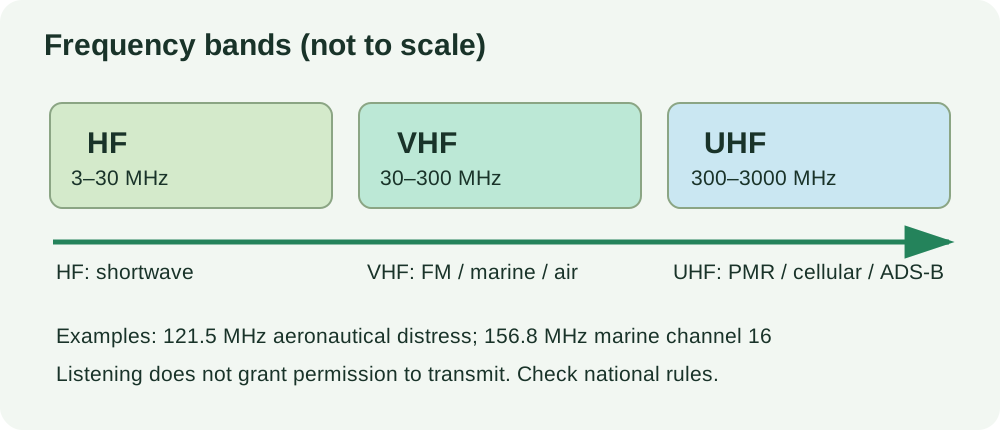
HF spans 3–30 MHz and can support long-range contacts when propagation cooperates. VHF spans 30–300 MHz and is often line of sight. UHF spans 300–3000 MHz and is commonly used for local handheld communication and data.
Know critical frequencies
121.5 MHz is an international civil aviation distress frequency; 156.8 MHz is marine VHF channel 16; registered 406 MHz distress beacons serve satellite alerting systems. These are safety channels, not places to test homemade equipment.
Recognize common non-emergency services
Broadcast FM radio occupies 87.5–108 MHz in many countries; marine AIS normally broadcasts on 161.975/162.025 MHz; ADS-B aircraft data often uses 1090 MHz. European PMR446 operates in the 446 MHz band with compliant equipment and applicable national rules.
Match antenna, distance and conditions
Antenna placement, polarization, terrain, atmospheric conditions and cable losses can dominate performance. Even a powerful transmitter cannot guarantee reception behind a mountain. Check batteries and line-of-sight paths before relying on equipment.
Separate receiving from transmitting
Receiving permissible public transmissions with a suitable receiver is distinct from transmitting. For two-way radios use certified equipment and appropriate licensing or licence-exempt allocations for the exact country. Amateur-radio privileges are not universal.
Prepare an emergency plan
Keep a battery-powered broadcast receiver and written contact schedule, call signs when legally assigned, emergency channels, family meeting points, backup charging and a shared message format. Do not block a distress frequency with routine traffic.
Reference frequency examples
Frequencies below are illustrations of common services, not a licence to transmit. Country-specific channel plans and conditions of use still apply.
| Frequency | Service | Notes |
|---|---|---|
| 3–30 MHz | HF band | Shortwave propagation depends on conditions. |
| 87.5–108 MHz | Broadcast FM | Region-dependent allocations. |
| 121.5 MHz | Aviation distress | Protected emergency frequency. |
| 156.8 MHz | Marine VHF channel 16 | Distress, safety and calling where applicable. |
| 161.975 / 162.025 MHz | Marine AIS 1 / AIS 2 | Public vessel identification data broadcasts. |
| 446 MHz band | PMR446 (Europe) | Compliant handhelds; local rules apply. |
| 978 MHz | UAT ADS-B (US) | Regional aircraft data link. |
| 1090 MHz | Mode S / ADS-B | Aircraft data broadcasts. |
Related guides
Reference sources
Verify local laws and manufacturer guidance before field use. Information reviewed November 2026.