Field principle
Morse is a pattern of short and long signals, not a language. Practise with a battery LED, whistle or other permitted signal method; transmitting by radio can require authorization.
On this page
Timing and distress signals
- Dot: Basic signal unit (one unit).
- Dash: Three dot units.
- Inside a letter: One unit of silence between elements.
- Between letters: Three units of silence.
- Between words: Seven units of silence.
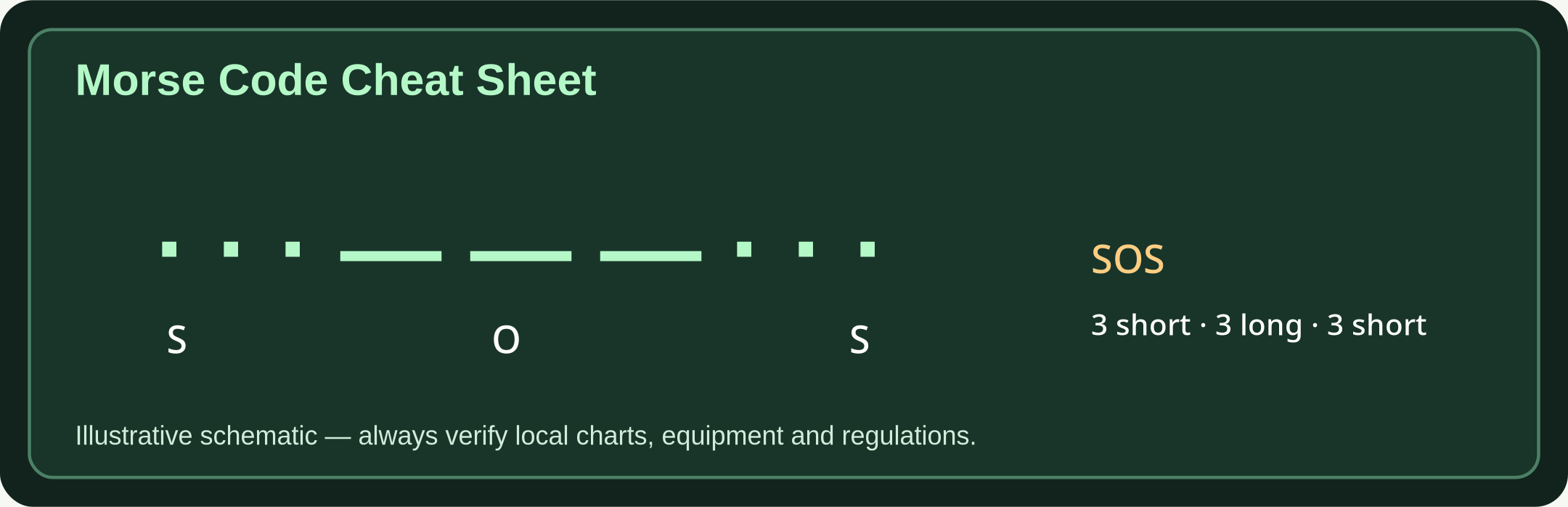
- SOS: ... --- ... (repeated as needed). In formal Morse procedure SOS is a continuous prosign without letter gaps.
- Check response: Do not assume a coded light or sound signal has been noticed; prioritize official emergency channels.
Practical field drill
- Prepare: Use a fixed light source or low-voltage battery LED and agree on the alphabet before use.
- Begin slowly: Send a familiar short word using clearly distinct signal timings.
- Receive: Listen or watch for full letter groups; write down the character only after the letter-space.
- Confirm: Repeat essential information and verify that the recipient understood it.
International Morse alphabet and numbers
Dot = · = short. Dash = − = long. The characters below are International Morse, not an audio recording.
A·−
B−···
C−·−·
D−··
E·
F··−·
G−−·
H····
I··
J·−−−
K−·−
L·−··
M−−
N−·
O−−−
P·−−·
Q−−·−
R·−·
S···
T−
U··−
V···−
W·−−
X−··−
Y−·−−
Z−−··
0−−−−−
1·−−−−
2··−−−
3···−−
4····−
5·····
6−····
7−−···
8−−−··
9−−−−·
Reference: ITU-R M.1677 international Morse code standard.
Further reading & source material
Use these sources to validate local rules, technical standards and updates. No emergency article replaces official alerts or trained responders.