Field principle
Listen to authorized public broadcasts and permitted radio services. Monitoring private communications and transmitting without authorization may be illegal. Frequencies and channel allocations depend on country; check the local regulator and official notices.
On this page
Radio bands and what to expect
- Medium wave / AM broadcast: Roughly 0.5–1.7 MHz depending on region; carries public broadcasts.
- FM broadcast: Typically 87.5–108 MHz in Europe; public broadcasting and news.
- Shortwave HF: Roughly 3–30 MHz encompasses multiple broadcast and licensed radio services; reception varies with solar conditions and time.
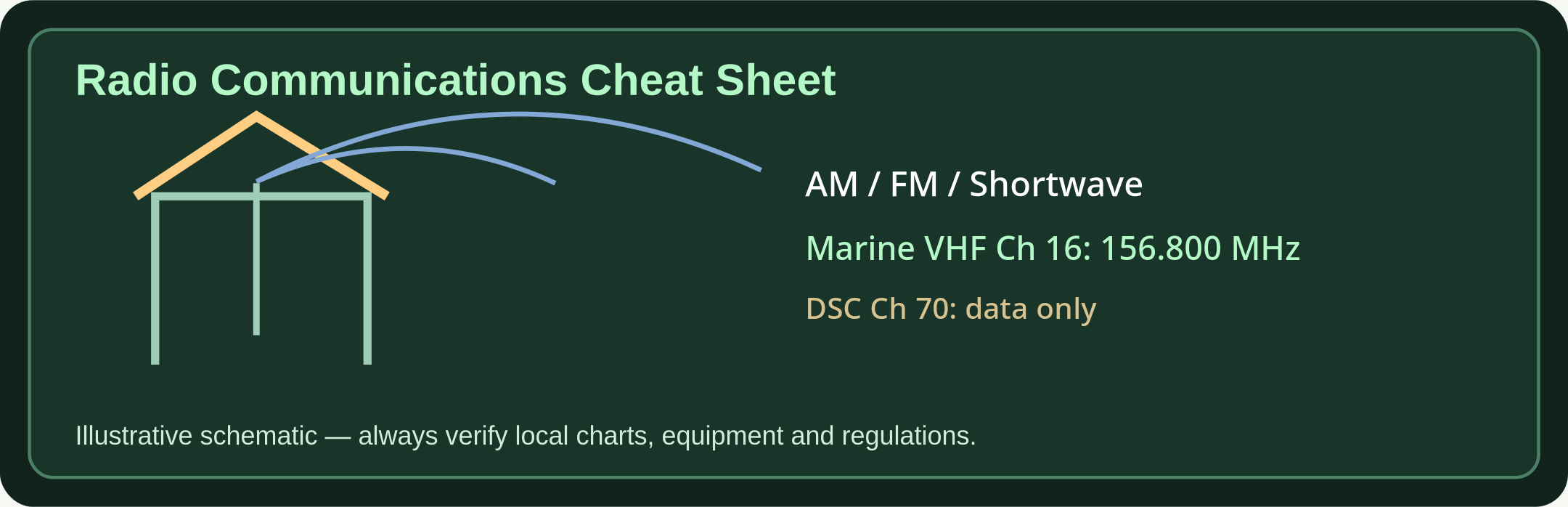
- VHF marine channel 16: 156.800 MHz: international maritime distress, safety and calling voice channel; not a general entertainment channel.
- VHF marine channel 70: 156.525 MHz: digital selective calling (DSC) only, not voice traffic.
- NOAA Weather Radio (United States): 162.400–162.550 MHz across seven designated frequencies; regional coverage.
- Amateur radio: Permitted frequencies vary by region, class and licence; listen or transmit only as legally authorized.
What a listening station is
- Official weather/alert broadcasts: Use public radio channels and official local alert sources. NOAA Weather Radio applies in the US, not globally.
- Marine coast radio / MRCC: Coast stations and maritime rescue coordination centres provide safety services; coverage and listening schedules vary.
- Voluntary vessel radio watch: Marine crews may keep a watch on safety channels under local rules and operational conditions.
- Shortwave broadcasts: International broadcasts can travel far; keep a printed local station/frequency and schedule list and test reception.
- Radio scanner caution: Do not attempt to intercept private, encrypted or restricted transmissions. The ability to receive a signal does not automatically make interception lawful.
Make an emergency call clearly
- Choose correct channel: Use the designated emergency channel for your service and country. On marine VHF, Ch 16 is voice distress and Ch 70 DSC alerting.
- Lead with urgency: Distress MAYDAY is for grave and imminent danger; follow applicable maritime radio procedures.
- State essentials: Who you are; exact location or bearing; nature of emergency; assistance needed; number of people; repeat as instructed.
- Conserve battery: Keep nonessential traffic short, listen for responses, and maintain the watch where safe.
- Use redundancy: Have alternative ways to summon help such as emergency phone, registered beacon, visual signals and written contact list.
Make a quick listening log
- Record: Date/time (UTC), station name, frequency, mode (AM/FM/SSB), program, signal strength and source.
- Verify: Compare with up-to-date official frequency tables, current station schedules and local band plans.
- Do not rely on one source: Coverage changes due to terrain, propagation, outages, regulations and equipment.
Further reading & source material
Use these sources to validate local rules, technical standards and updates. No emergency article replaces official alerts or trained responders.