Immediate rule
Prepare before services fail. In the Netherlands, plan for at least 72 hours and about 3 litres of water per person per day, then adapt for health, climate and household needs.
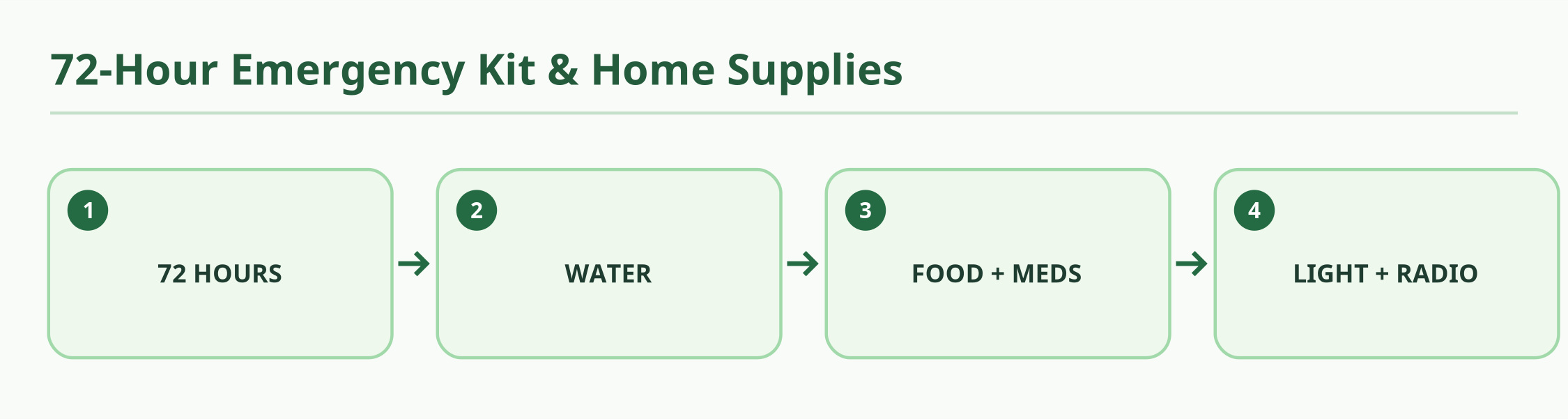
Five practical skills
Use these steps for preparation and decision-making. Emergency responders and live warnings take priority.
Plan the people and the time
Rule: Design around your household, not a generic bag.
- List every household member, visiting child, pet and person with medical or accessibility needs.
- Begin with 72 hours of food, drinking water, warmth, medication and communication; adjust for heat, illness or local guidance.
- Keep supplies in an accessible, dry place and tell everyone where they are.
Store safe drinking water
Rule: Clean water is a priority.
- Allocate at least 3 litres per person per day under Dutch guidance; for four people, 72 hours means 36 litres.
- Add extra water for infants, pets, hot conditions and hygiene; follow local alerts when tap water is unsafe.
- Use sealed, food-grade containers, mark dates and replace or inspect according to storage guidance.
Pack food, hygiene and health essentials
Rule: Choose supplies that work without electricity.
- Select shelf-stable food your household eats, plus a manual can opener and allergy-aware options.
- Include regular medicines, prescriptions, first-aid supplies, sanitary products, soap and waste bags.
- Plan for safe food preparation without indoor fuel-burning devices; never use outdoor grills or generators indoors.
Keep information and light available
Rule: A kit should still work with no mobile signal.
- Pack LED torches, spare batteries, a charged power bank and the correct cables.
- Include a battery or hand-crank radio, printed contacts, key documents and local route maps.
- Keep small amounts of cash, spare keys, warm clothing and a whistle in a waterproof pouch.
Inspect and practice
Rule: Supplies that fail at the moment of need are not preparedness.
- Check expiration dates, batteries, stored water, clothing sizes and medication requirements every few months.
- Test the radio and torch, rotate food into normal household use and recharge the power bank.
- Do a short no-electricity drill and record what was missing; update the kit afterwards.
Practice before an emergency
- Calculate the water requirement for everyone in your household.
- Assemble a small kit in one reachable container.
- Set calendar reminders to check supplies and batteries.
Safety and local guidance
Training, weather, the vessel manufacturer, local laws and emergency services take precedence over these general notes. The correct response depends on real conditions.
Reference sources:
- Dutch government — emergency kit
- British Red Cross — emergency preparedness
- American Red Cross — make a plan
Review current official advice before applying high-risk guidance.