Immediate rule
Shout “Person overboard,” point continuously at the person and deploy available flotation immediately. Call for help if recovery cannot be made promptly and safely.
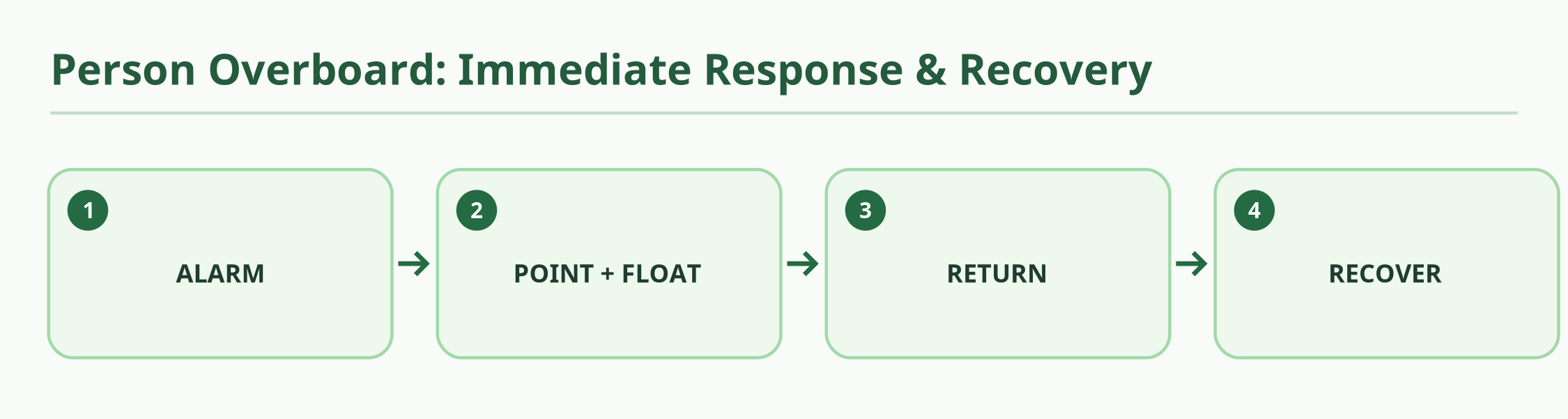
Five practical skills
Use these steps for preparation and decision-making. Emergency responders and live warnings take priority.
Raise the alarm and point
Rule: Do not lose visual contact.
- Shout clearly to alert everyone; assign one person to point and maintain uninterrupted sight of the casualty.
- Throw a lifebuoy, flotation cushion or rescue marker if available; activate a position marker or MOB button.
- Call the appropriate rescue service early if the person may be lost, injured, unconscious or difficult to recover.
Control the vessel
Rule: Avoid propellers and secondary casualties.
- Reduce speed and follow the craft-specific return manoeuvre taught in training.
- Keep a lookout for the casualty relative to wind, waves and the hull; use a trained helmsman.
- Put the engine in neutral and stop it as needed before the casualty reaches the propeller area, following vessel-specific procedures.
Approach and recover safely
Rule: Rescue gear reduces risk to the whole crew.
- Approach at the slowest controlled speed suitable for conditions, avoiding propeller and hull injury.
- Use a ladder, recovery sling or hoist appropriate to the person and craft; uncontrolled lifting can injure.
- Do not send an unprotected rescuer into the water; call for professional rescue if recovery is beyond crew capability.
Treat cold-water exposure
Rule: Breathing and consciousness are the immediate priorities.
- Once recovered, move the person to shelter and assess responsiveness and normal breathing.
- Call emergency services for drowning, breathing difficulty, reduced consciousness or significant cold exposure.
- Remove wet clothing when safe, insulate and warm gradually; follow current first-aid or dispatcher guidance.
Prevent recurrence
Rule: Manage the risk before another incident.
- Review lifejacket fit, deck grip, guardrails, tether rules and nighttime procedures.
- Check whether crew training, weather limits or deck routines need improvement.
- Practise recovery techniques in controlled conditions using a floating dummy, not an unprotected person.
Practice before an emergency
- Assign a dedicated spotter during a mock MOB drill.
- Locate the flotation, MOB button and recovery equipment.
- Practise the manoeuvre only in a controlled training setting.
Safety and local guidance
Training, weather, the vessel manufacturer, local laws and emergency services take precedence over these general notes. The correct response depends on real conditions.
Reference sources:
- RNLI — boating and sailing safety
- RNLI — how to call for help at sea
- US Coast Guard — VHF MAYDAY procedure
- NWS — boating in thunderstorms
Review current official advice before applying high-risk guidance.