Immediate rule
Write down the plan before an incident. During an immediate threat, contact local emergency services and follow official alerts rather than waiting for everyone to answer.
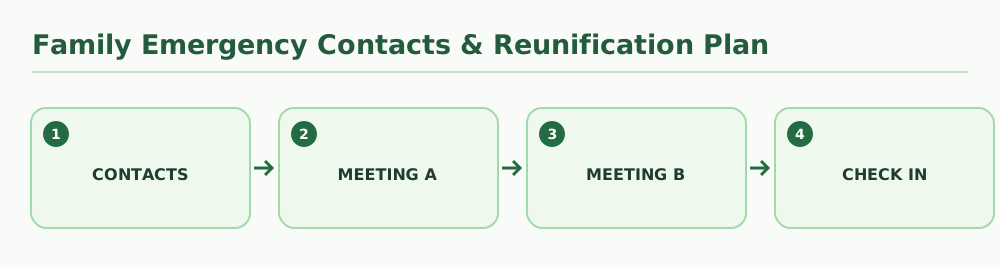
Five practical skills
Use these steps for preparation and decision-making. Emergency responders and live warnings take priority.
Define contacts and responsibilities
Rule: Use one plan that everyone can understand.
- Record emergency numbers, a trusted out-of-area contact, nearby caregivers and critical medical contacts.
- Assign roles: who checks on children, who assists mobility needs and who brings essential supplies.
- Place concise contact cards in bags and with trusted carers; protect private medical details.
Agree two safe meeting places
Rule: A single location may be inaccessible.
- Pick a nearby place for a local building evacuation and another place outside the immediate hazard area.
- Explain how to reach each place without depending on one route or public transport.
- Check that each meeting place stays appropriate under common flood, fire or extreme-weather risks.
Use a short check-in message
Rule: Reduce confusion and battery use.
- Agree on a format: name / current location / condition / time / next step.
- Send concise texts to your designated contact when safe; avoid repeatedly calling every family member.
- If internet messaging fails, try normal voice or SMS when available and use the written plan.
Prepare for low connectivity
Rule: Keep a backup outside your phone.
- Save maps for offline use, keep a paper map and a list of useful radio/alert sources.
- Pack a charged power bank and a weather-protected copy of identification and insurance contacts.
- Do not assume satellite SOS, emergency text or roaming is universally available; check device and country support in advance.
Rehearse and review
Rule: A written plan is only useful if people know it.
- Walk through a hypothetical power outage and evacuation with every household member.
- Practise finding the kit and meeting-place route without electronic navigation.
- Update contacts, schools, medications and arrangements at least twice a year.
Practice before an emergency
- Create a wallet-size emergency contact card.
- Agree on an out-of-area contact and two meeting places.
- Run a ten-minute communication drill.
Safety and local guidance
Training, weather, the vessel manufacturer, local laws and emergency services take precedence over these general notes. The correct response depends on real conditions.
Reference sources:
- Dutch government — emergency kit
- British Red Cross — emergency preparedness
- American Red Cross — make a plan
Review current official advice before applying high-risk guidance.