Field guide · Fishing & Food
Purpose and safe boundaries
Illustrated field instructions for a flexible rod, safe barbless hook, line selection, secure knots and pre-use testing.
Reviewed: November 2026. This educational guide does not replace accredited training, equipment manuals, local rules, medical professionals or live emergency instructions.
Build only where fishing is legal
Improvised fishing equipment may be less reliable than a basic commercial hook, monofilament line and telescopic travel rod. Pack a small repair kit as your first choice. Observe local licences, closed seasons, protected species, catch limits and water-quality warnings. Wear eye protection when shaping wire and keep sharp points away from children.
Diagram: simple hand-built rod and barbless hook
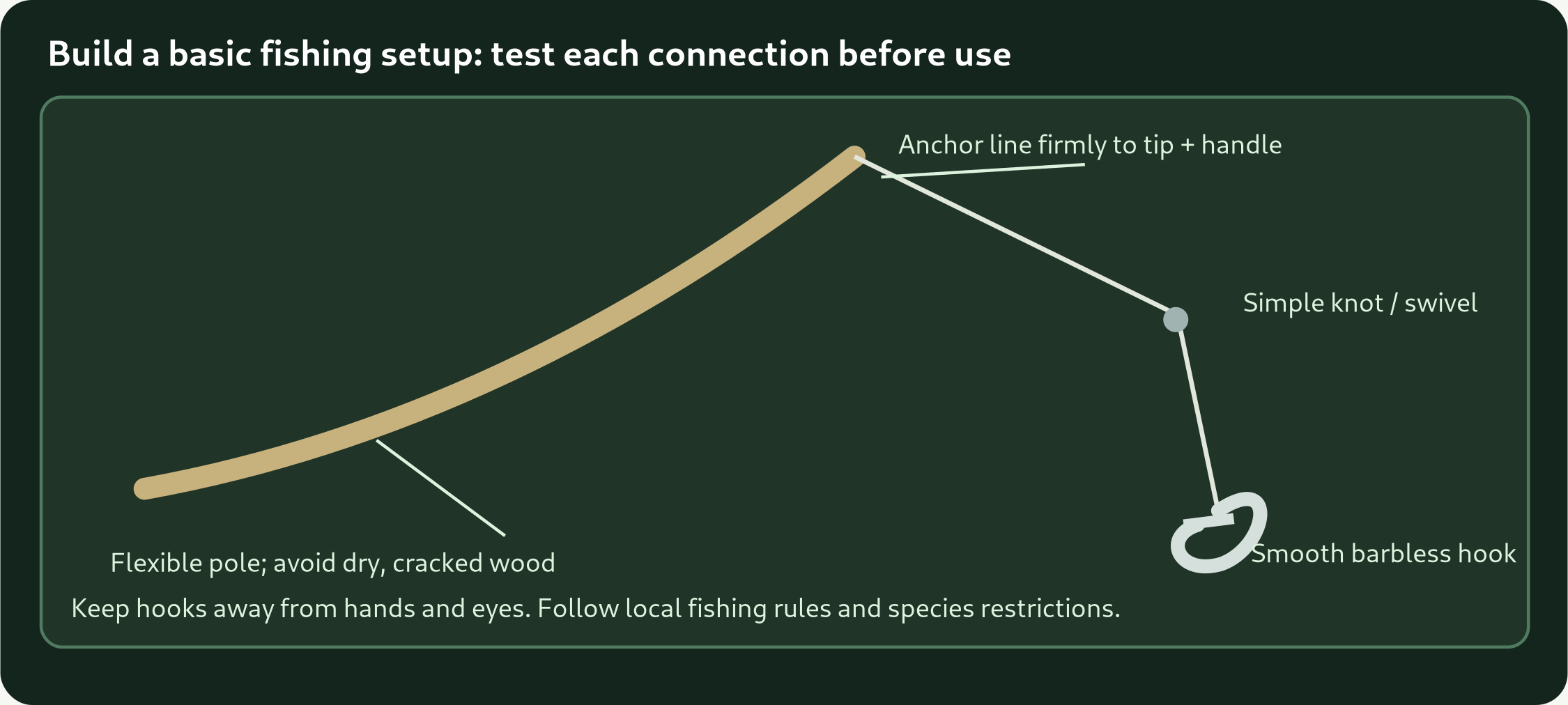
Select a safe rod and handle
- Choose a straight, flexible, sound pole about 1.5–3 m long, subject to local conditions; a lightweight telescopic rod is safer and more dependable.
- Reject rotten, sharp, cracked or splintered material. Smooth the grip and tip without weakening the shaft.
- Secure the line to the handle first, then along the pole to the tip so it is not lost if the tip breaks.
- Never fish near overhead power lines or during thunderstorms; carbon and wet rods can conduct electricity.
Choose and prepare the fishing line
Reliable option: use rated nylon monofilament or braided fishing line of an appropriate breaking strain. A short commercial leader reduces tangles, and swivels help with twisting lures. Emergency alternative: evenly twisted clean cordage can hold a passive handline but is much less predictable, abrades faster and becomes weaker when wet; do not rely on it for a heavy catch. Never use mains electrical wire as fishing line or leave wire fragments in water.
Make a small barbless hook from suitable wire
- Prefer a store-bought barbless fishing hook. If you must make one, use corrosion-resistant springy metal of known condition, free of cracks and coatings.
- Cut a short length with pliers and secure it; keep offcuts in a container so no sharp scraps remain.
- Bend a smooth, open hook curve slowly around a small mandrel; make a line tie loop at the other end. Avoid heating unknown metal, which can weaken it or release hazardous fumes.
- Smooth burrs carefully and cover the point during travel. Reject hooks that twist or fracture under a controlled pull; test away from people.
Knots, bait and test method
Use a recognized fishing knot such as the improved clinch or Palomar knot with compatible line; lubricate nylon with water, tighten evenly and trim only after checking for slip. Attach the hook through its eye or loop and test the complete setup over soft ground before reaching water. Keep bait in a closed container and never introduce prohibited organisms into a waterway.
Repair and hygiene checklist
After each trip inspect guide edges, chafed knots and rusty components; replace damaged pieces instead of compensating with extra tension. Store hooks capped, dry line in a spool and pack all discarded filament out of nature. Keep fish cold and cook properly when legally retaining a catch; check local consumption advisories.
Related survival guides
References and further reading
Checked against publicly available guidance; verify local rules and the manufacturer’s current manual before use.
Illustrated tackle and wild-food links
Open rod, line and hook illustrationDownload image
Choose springy green wood for a hand rod, smooth and test your line before use, and crimp improvised hooks so they hold shape under load. For bait and accompanying plant foods, cross-reference the Illustrated Wild Edible Foods Reference.