Immediate rule
Protect people first. A growing fire, uncontrolled flooding or loss of safe navigation can become life-threatening quickly: call for assistance early.
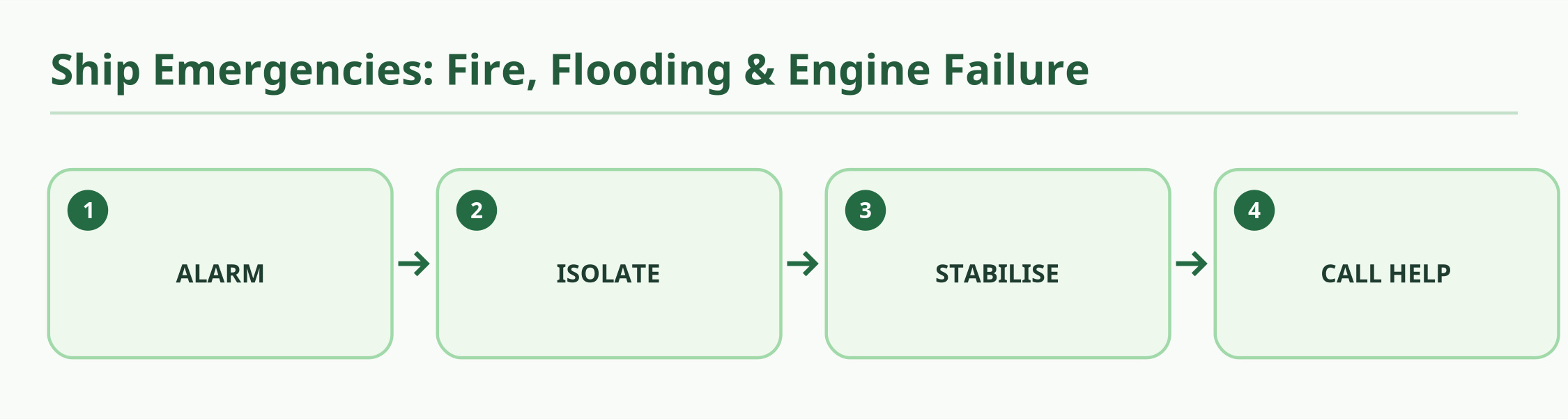
Five practical skills
Use these steps for preparation and decision-making. Emergency responders and live warnings take priority.
Recognise and communicate the incident
Rule: Alert crew and establish control.
- Raise the alarm, account for passengers and require lifejackets as conditions demand.
- Identify whether fire, water ingress, smoke or propulsion failure threatens stability or people.
- Call nearby assistance or send a distress/urgency message when appropriate; give your exact position.
React safely to fire
Rule: Do not fight a fire you cannot safely escape.
- Keep people clear of smoke and establish an exit route; isolate fuel, gas or electrical power only if safe and trained.
- Use only suitable onboard extinguishers on small, contained fires with a clear escape path.
- If fire spreads or smoke becomes severe, prioritise evacuation to a safe area and professional rescue.
Respond to flooding
Rule: Stability and escape routes matter.
- Locate ingress only if access is safe; do not enter flooded or electrically dangerous compartments.
- Use installed bilge pumps or bailing equipment while maintaining lookout and safe vessel stability.
- If flooding cannot be controlled, issue a distress call and prepare survival equipment early.
Manage loss of propulsion
Rule: Keep the boat clear of danger.
- Maintain lookout; assess drift, current, rocks, shipping lanes and weather.
- If suitable and trained, check simple causes such as fuel or battery without going near moving machinery.
- Use a properly sized anchor when appropriate and safe; request tow or rescue help before drifting into danger.
Prepare for escalation
Rule: Do not delay rescue planning.
- Gather people, lifejackets, communications, beacon and essential emergency equipment in an accessible location.
- Confirm whether there is a liferaft or other survival craft and how it is deployed.
- Follow rescue service directions and remain with a safely floating vessel whenever appropriate.
Practice before an emergency
- Point out fuel isolation, fire extinguisher, bilge pump and anchor.
- Practise reporting a vessel position without a phone app.
- Brief the crew on escalation and assembly points.
Safety and local guidance
Training, weather, the vessel manufacturer, local laws and emergency services take precedence over these general notes. The correct response depends on real conditions.
Reference sources:
- RNLI — boating and sailing safety
- RNLI — how to call for help at sea
- US Coast Guard — VHF MAYDAY procedure
- NWS — boating in thunderstorms
Review current official advice before applying high-risk guidance.