Immediate rule
Reduce sail early and seek safe harbour before severe weather overtakes the vessel. Heavy-weather decisions require training appropriate to the craft and conditions.
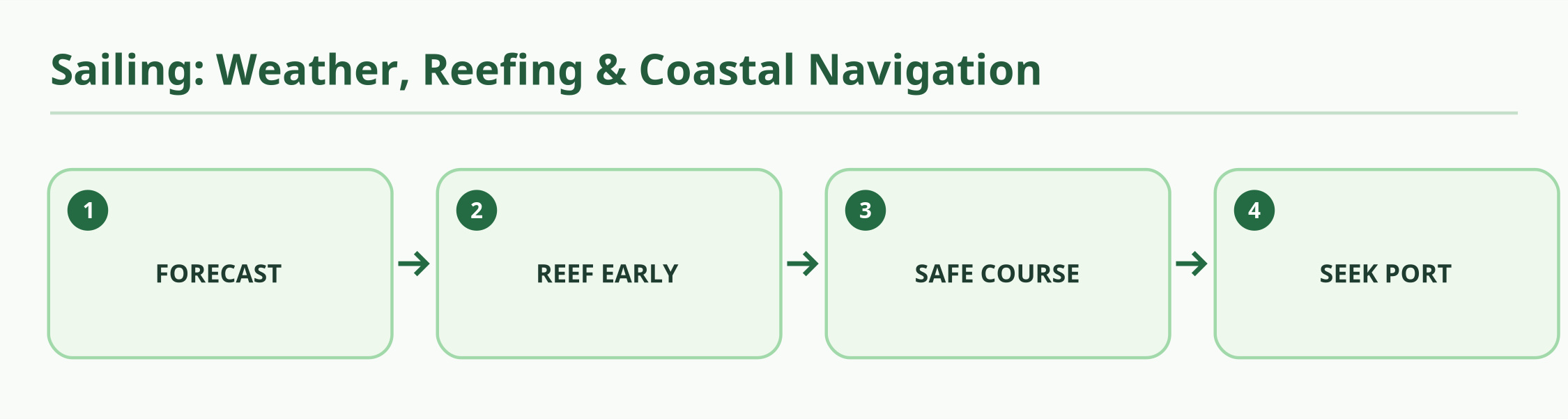
Five practical skills
Use these steps for preparation and decision-making. Emergency responders and live warnings take priority.
Read the marine forecast
Rule: Make decisions for the whole passage.
- Check wind direction and gusts, wave height and period, sea state, visibility and thunderstorm risk.
- Consider headlands, tidal races and the effect of wind against current.
- Write down forecast update times and several places to stop or shelter along the route.
Reef before conditions escalate
Rule: Do not wait until the crew is overloaded.
- Check that reefing gear is functional before leaving and identify the safest sequence for your rig.
- Shorten sail in a controlled way while the deck is still manageable; use harnesses/tethers where appropriate.
- Avoid sending untrained crew to exposed positions during worsening conditions.
Navigate with margins
Rule: Position uncertainty grows when visibility and electronics degrade.
- Use up-to-date charts and compare GPS with landmarks, depths and other independent cues when available.
- Account for leeway, tidal set, traffic separation and restricted areas.
- Mark a safe distance from lee shores and submerged hazards; keep a paper chart or independent navigation backup.
Manage the crew and watch
Rule: Fatigue causes errors.
- Assign lookout and helm responsibilities, communicate turns and sail changes clearly, and use safe deck movement.
- Keep people clipped on as appropriate and prevent unnecessary deck trips in rough conditions.
- Monitor dehydration, cold exposure, seasickness and reduced alertness; reduce workload or turn back early.
Respond to rapid weather changes
Rule: Safe shelter is often the best manoeuvre.
- If thunderstorms threaten, head for port or safe shelter when feasible; do not start an exposed passage.
- In lightning conditions follow national marine guidance, avoid contact with metal/electronics as appropriate and seek protected areas.
- Use the vessel-specific heavy-weather plan and call for help early if control or safe navigation is in doubt.
Practice before an emergency
- Record wind, swell, tide and a safe-harbour alternative for a sample passage.
- Practise reefing at the dock or in settled conditions with an instructor.
- Review navigation and lightning procedures with the crew.
Safety and local guidance
Training, weather, the vessel manufacturer, local laws and emergency services take precedence over these general notes. The correct response depends on real conditions.
Reference sources:
- RNLI — boating and sailing safety
- RNLI — how to call for help at sea
- US Coast Guard — VHF MAYDAY procedure
- NWS — boating in thunderstorms
Review current official advice before applying high-risk guidance.