Immediate rule
Five skills to master
Learn these five competencies in order. Each section below gives a rule, a procedure, and the boundaries that prevent common mistakes.
Evacuation decision and alerts
- Identify the trigger. Use official alerts, responder instructions, smoke/fire behavior, rising water, structural damage, hazardous-material warnings, or other direct evidence.
- Leave early. Delay makes traffic, smoke, fire, water, darkness, and road closures worse. Once the decision is made, switch from “prepare” to “move.”
- Take people first. Account for children, older adults, disabled people, visitors, and pets before collecting property.
- Use only the time you actually have. Grab the prepared bag, essential medication, phone, keys, ID, protective clothing, and water. Skip nonessential packing.
- Do not re-enter. Return only when the responsible authority or property owner says conditions are safe.
Go-bag and communication plan
- Core bag. Water, ready-to-eat food, first aid, flashlight/headlamp, power bank/cables, weather layer, gloves, hygiene items, cash, paper map, whistle, and copies of key documents.
- Personal necessities. Prescription medication, glasses, hearing-aid batteries, mobility items, infant supplies, and pet equipment.
- Two meeting points. Choose one nearby and one outside the neighborhood. Choose an out-of-area contact who can relay information.
- Write it down. Keep phone numbers, medical needs, and meeting points on paper in case phones are dead or locked.
- Send one concise message. Destination, route, people with you, vehicle description if relevant, and expected check-in time.
Route planning and movement
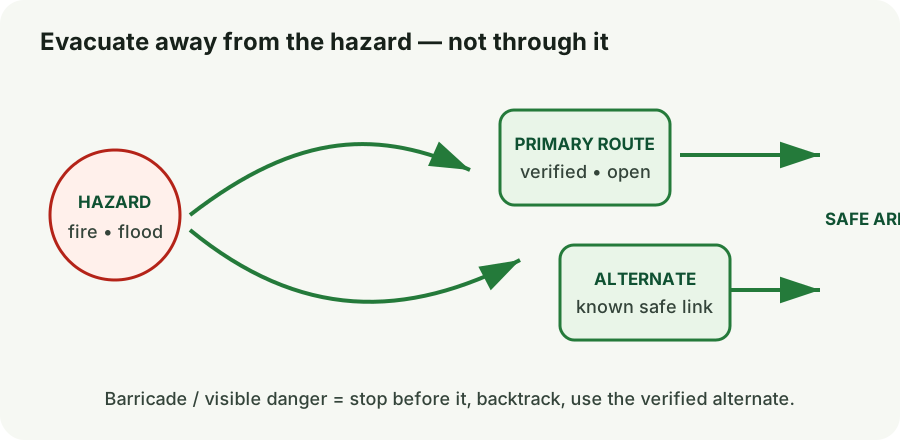
- Plan two exits. Know a primary and alternate route from home, work, school, and regular travel areas.
- Follow closures and direction controls. Barricades and one-way evacuation traffic exist because downstream conditions may be hidden from you.
- Scan ahead. Watch for smoke, downed wires, moving water, damaged bridges, debris, unstable trees, and changing wind.
- Keep fuel/charge margin. During high-risk seasons, avoid routinely running the vehicle near empty. Do not depend on a single charging/fuel stop.
- If the route fails, stop before the hazard. Backtrack to a known safe point or use the alternate route; do not force through water, flame, debris, or unstable structures.
Practical note
A “shortcut” through an unverified area is not an alternate route. Pre-plan alternates that reconnect with known roads or safe terrain.
Flood escape
- Move uphill early. Flash flooding can rise faster than a person can judge from a single viewpoint.
- Do not cross moving water if another route exists. Depth, current, submerged debris, and washed-out road surfaces are hard to judge.
- Keep away from electricity. Water may be energized by downed lines or damaged equipment.
- Leave a trapped vehicle only for a clearly safer position. If water is rising around the vehicle, follow local emergency guidance and call for rescue if possible.
- After the water passes, treat the area as contaminated and structurally uncertain. Avoid unnecessary contact with floodwater and damaged buildings.
Important limit
Do not use dry washes, drainage channels, underpasses, or narrow canyons as escape routes when heavy rain or flash flooding is possible.
Wildfire and outdoor escape
- Wildfire: leave on the instructed route with windows closed and ventilation on recirculate if smoke is heavy. Keep headlights on when visibility is poor.
- Do not drive through visible flame fronts. If trapped, call emergency services with the most precise location available and follow responder instructions.
- Terrain hazards: move out of ravines, avalanche paths, rockfall zones, exposed ridges, flood channels, and other obvious runout areas before stopping.
- Once clear, stop. Check the map/location, injuries, weather, remaining daylight, and communications before continuing.
- Switch to signaling/navigation. If you do not know a safe route, do not turn evacuation into uncontrolled travel.
Practice before an emergency
- Set two evacuation routes from home and one meeting point outside the neighborhood.
- Pack and weigh a go-bag; remove items you cannot realistically carry.
- Do a timed 10-minute departure drill without actually driving away.
- Download offline maps and local alert apps before disaster season.
- Include pets, mobility needs, and medication refill timing in the plan.
Use guides as references, not substitutes for training
Conditions, local law, official emergency instructions, product instructions, and hands-on training can change what is appropriate. When an emergency service or responsible authority gives you a specific instruction for the active incident, follow it.
Source links are included so the guide can be checked against current official guidance. Review dates and local instructions before high-risk travel or seasonal hazards.
Related essential field guides
Additional procedures and printable references: