Immediate rule
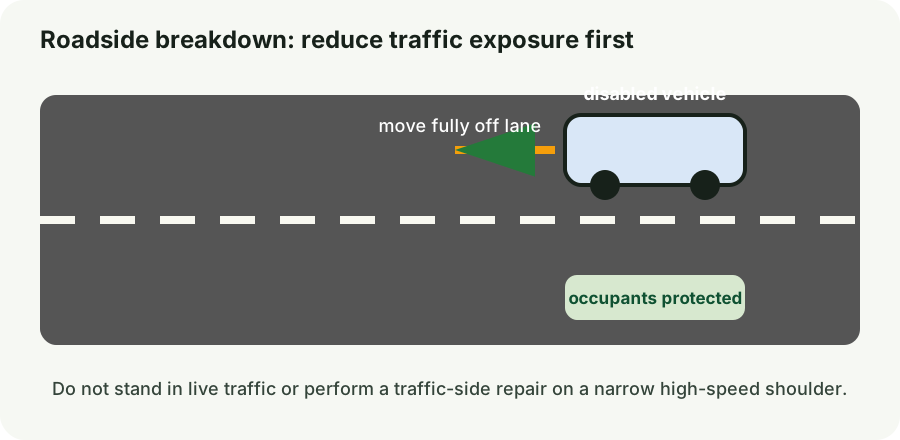
If the vehicle can move, get fully out of the travel lane. Use hazard lights, call for help with exact location, and avoid roadside repairs on the traffic side when the shoulder is narrow or traffic is fast.
Five skills to master
Learn these five competencies in order. Each section below gives a rule, a procedure, and the boundaries that prevent common mistakes.
Stabilize the vehicle and occupants
Rule: The first emergency is traffic exposure. Put distance and a barrier between people and moving vehicles whenever possible.
- Move off the travel lane if the vehicle can do so safely. Prefer a parking area, turnout, wide shoulder, or exit over a narrow high-speed shoulder.
- Turn on hazard flashers. Keep seat belts on while the vehicle is in a vulnerable position.
- Assess fire, smoke, fuel smell, water, unstable shoulder, and collision risk. These hazards can make staying inside unsafe.
- Exit away from traffic when safe. Do not stand between vehicles or in front/behind a disabled vehicle where it could be struck.
- Do not place warning devices by walking in live traffic. Visibility equipment is useful only when it can be deployed without creating greater risk.
Call for help with exact location
Rule: A precise location and hazard description reduces responder search time and prevents the wrong type of assistance being sent.
- Give road/highway, direction of travel, nearest exit/marker, lane/shoulder position, and GPS coordinates if available.
- Give vehicle description and plate.
- State number of occupants and injuries.
- Report traffic hazards. Disabled lane, blind curve, smoke/fire, downed wires, floodwater, or poor visibility may require police/fire response rather than ordinary roadside service.
- Keep the phone available for callback. Use low-power mode while waiting.
Decide whether to stay or leave
Rule: Stay with the vehicle when it is safely off the road and provides shelter/visibility; leave it when fire, flood, collision exposure, or another immediate hazard makes it unsafe.
- Safe shoulder/remote area: remaining with the vehicle is often easier for rescuers to locate than a person walking away.
- Active traffic danger: if directed or clearly safer, move occupants to a protected position well away from traffic, ideally behind a barrier.
- Fire/fuel leak: evacuate upwind and uphill when practical and call emergency services.
- Flood: never drive into water covering the road; if trapped by rising water, call emergency services and follow local flood guidance.
- Do not walk along a high-speed roadway for help unless staying is more dangerous and there is a clearly safer destination.
Winter and low-visibility stranding
Rule: In blowing snow or poor visibility, the vehicle is usually a better shelter and search target than a person on foot.
- Stay with the vehicle unless it is unsafe.
- Keep the exhaust pipe clear of snow before running the engine for heat. Recheck it as snow drifts.
- Never idle inside an enclosed or partly enclosed area.
- Use dry layers and blankets; avoid sweating. Run lights/engine only as needed while preserving fuel/battery according to vehicle guidance.
- Make the vehicle visible without exposing yourself to traffic. Use interior light, hazard lights, or a bright cloth where appropriate.
Safe repair limits and remote-trip preparation
Rule: A repair is not “simple” if it puts your body in the traffic lane or under an unstable vehicle.
- Tire change: do it only on firm level ground, out of traffic, with the parking brake set and the correct jack points/tools. Never put any part of your body under a vehicle supported only by a jack.
- Jump start: follow both vehicles’ manuals or the jump-pack instructions; damaged/frozen/leaking batteries require professional help.
- Before remote travel: check tires, fuel/charge, weather, closures, recovery options, and spare/repair equipment.
- Tell someone the route and ETA.
- Carry delay supplies: water, food, first aid, light, warm/rain layers, phone power, paper/offline map, gloves, and season-specific traction/shovel items.
Practice before an emergency
- Locate the vehicle’s jack points and spare/tire repair equipment before you need them.
- Save roadside assistance and insurer numbers offline.
- Practice sharing your exact map pin/coordinates.
- Pack a season-specific roadside kit and inspect it twice a year.
- Set a rule: no traffic-side repair if your body cannot remain fully outside the travel lane.
Use guides as references, not substitutes for training
Conditions, local law, official emergency instructions, product instructions, and hands-on training can change what is appropriate. When an emergency service or responsible authority gives you a specific instruction for the active incident, follow it.
Reference sources:
- NHTSA — Driving in Severe Weather
- NHTSA — Summer Driving Tips
- National Weather Service — Winter Storm Safety
- CDC — Clear Snow From Tailpipes
Source links are included so the guide can be checked against current official guidance. Review dates and local instructions before high-risk travel or seasonal hazards.