Immediate rule
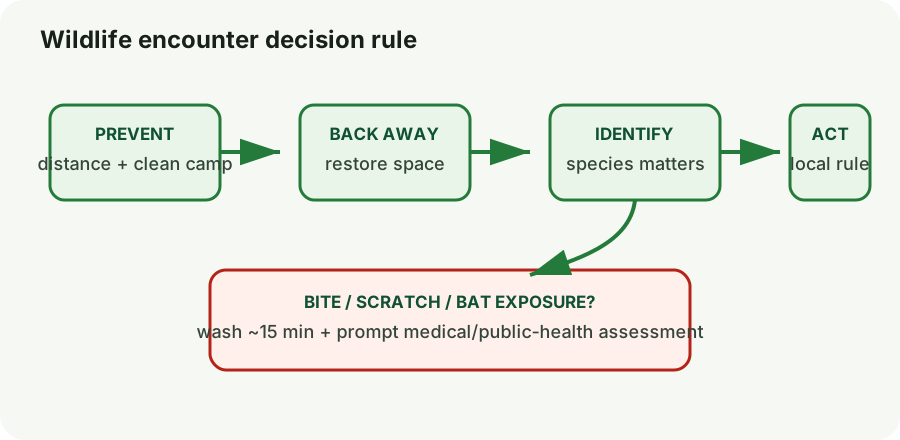
Five skills to master
Learn these five competencies in order. Each section below gives a rule, a procedure, and the boundaries that prevent common mistakes.
Distance and encounter prevention
- Learn the local species and current land-manager rules before entering the area.
- Never feed, touch, corner, chase, or approach wildlife for photographs.
- Keep children close and pets controlled as local rules require.
- Watch for tracks, scat, carcasses, dens/nests, young animals, and poor-visibility vegetation.
- If an animal approaches, back away and restore distance rather than trying to hold position for a better view.
Food, scent, and camp control
- Secure all food, trash, pet food, cookware residue, and scented toiletries immediately.
- Use the storage method required locally. This may be a locker, approved bear-resistant container, hard-sided vehicle under specific conditions, or another mandated method.
- Never store attractants in the sleeping area where local rules prohibit it.
- Clean cooking areas and pack out food scraps. Do not burn food waste in an ordinary campfire.
- Keep food storage closed/locked even while you are nearby.
Bear, cougar, and moose response
- Bear: do not run. Give space, avoid blocking its route, and follow the current rules for the specific bear species and park/region. Defensive vs predatory behavior requires different responses, so local instruction matters.
- Cougar/mountain lion: face the animal, remain upright, make yourself appear larger, keep children close, back away slowly, and fight back if attacked.
- Moose: give very large space, especially cows with calves. If it notices you, speak softly and move away. If charged, get behind a solid object such as a large tree/vehicle when possible.
- Do not climb, run, or play dead by default for every species. Those are species/situation-specific tactics.
- Report aggressive or abnormal wildlife behavior to the land manager.
Important limit
Species-specific rules can differ by region and season. The correct “no debate” rule is: identify the animal, create distance, and follow current local land-manager guidance rather than applying one generic predator script.
Bear spray and deterrent readiness
- Carry it on your body where it can be reached immediately, not buried in a pack.
- Read the manufacturer label and local park guidance before the trip.
- Know the safety mechanism, spray duration, expiry, and wind implications.
- Use it as a deterrent when an encounter reaches the conditions described by local guidance/product training.
- Do not apply bear spray to people, tents, or gear as a “repellent.”
Bites, scratches, and rabies exposure
- Get away from the animal safely. Do not try to capture wild animals yourself.
- Wash bites/scratches immediately with soap and running water for about 15 minutes when possible.
- Control serious bleeding using first-aid principles.
- Seek prompt medical/public-health advice after bites/scratches from bats, unfamiliar mammals, animals acting abnormally, or exposures in places where rabies is present.
- Ask about tetanus and infection risk as well as rabies. Animal wounds can damage tendons/nerves and become infected even when rabies is not the issue.
Practice before an emergency
- Before a trip, look up the land manager’s wildlife page and food-storage rule.
- Practice opening your approved food container quickly and locking it correctly.
- Carry deterrent where legally appropriate and rehearse drawing it with an inert/training canister if available.
- Teach children “stop, stay close, back away—do not run toward or from wildlife.”
- Save the local park/ranger and public-health contact information offline.
Use guides as references, not substitutes for training
Conditions, local law, official emergency instructions, product instructions, and hands-on training can change what is appropriate. When an emergency service or responsible authority gives you a specific instruction for the active incident, follow it.
- National Park Service — Wildlife Safety
- National Park Service — Bear Safety: Storing Food
- National Park Service — Mountain Lion Safety
- CDC — Rabies Prevention and Control
Source links are included so the guide can be checked against current official guidance. Review dates and local instructions before high-risk travel or seasonal hazards.
Related essential field guides
Additional procedures and printable references: