Immediate rule
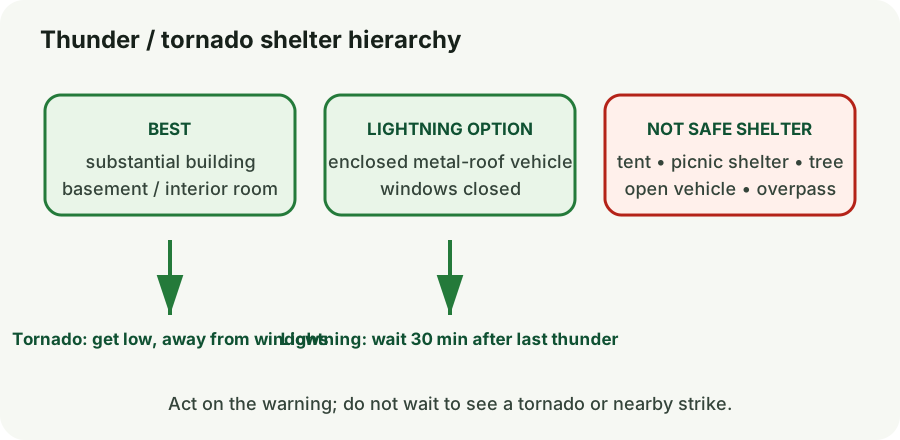
If you hear thunder, go immediately to a substantial building or enclosed metal-topped vehicle. For a tornado warning, move to a basement/safe room or the lowest interior room away from windows. Do not use tents, picnic shelters, overpasses, or isolated trees as safe storm shelter.
Five skills to master
Learn these five competencies in order. Each section below gives a rule, a procedure, and the boundaries that prevent common mistakes.
Read forecasts, watches, and warnings
Rule: A watch means conditions are possible; a warning means the hazard is occurring or imminent and protective action is required.
- Before the activity: check the local forecast, radar/alerts, and whether your destination has safe shelter.
- Enable emergency alerts. Keep at least one battery-powered method of receiving warnings during outages.
- At a watch: shorten exposure, identify shelter, charge devices, and be ready to stop the activity quickly.
- At a warning: act immediately. Do not wait for visual confirmation of a tornado or a nearby lightning strike.
- After a warning: keep monitoring until the hazard and secondary hazards have clearly passed.
Lightning shelter and 30-minute rule
Rule: There is no safe place outdoors during a thunderstorm. Thunder means you are close enough to be struck.
- Go inside immediately. Best choices are a substantial building with wiring/plumbing or an enclosed metal-topped vehicle with windows up.
- Avoid unsafe substitutes. Tents, picnic shelters, dugouts, gazebos, open vehicles, and isolated trees do not provide lightning protection.
- Inside a building: avoid corded phones, plumbing, plugged-in equipment, windows/doors, porches, and contact with concrete walls/floors.
- Stay sheltered. Remain in safe shelter for at least 30 minutes after the last thunder.
- Do not unplug equipment during the storm. Handle surge preparation before the storm arrives.
Tornado sheltering
Rule: Put as many walls as possible between you and the outside, get low, and protect the head and neck.
- Best: basement, storm cellar, or purpose-built safe room.
- If none: use a small interior room on the lowest floor, away from windows and large open rooms.
- Protect the body. Get under sturdy furniture if available and cover the head/neck with arms, a helmet, mattress, or thick blankets without delaying sheltering.
- Leave mobile homes/tents for a sturdy building before the storm arrives.
- Do not shelter under a highway overpass. It can expose you to accelerated wind and flying debris.
Destructive wind and hail protection
Rule: Treat severe straight-line wind like a tornado when structures and debris are at risk.
- Move indoors and away from windows.
- Use the lowest interior portion of the building when damaging wind is expected.
- Bring loose outdoor items in only before the storm. Do not go outside during a warning to secure property.
- Keep shoes, light, and a helmet/head protection nearby because broken glass and debris may be present after impact.
- Afterward, avoid downed lines, leaking gas, unstable trees, and damaged buildings.
Outdoor last-resort risk reduction
Rule: Outdoor actions can only reduce risk; they do not make a thunderstorm safe. Keep moving toward substantial shelter whenever one is reachable.
- Leave high ground. Get off summits, ridges, and open hilltops.
- Do not shelter under an isolated tree or rocky overhang.
- Get away from water and long conductive objects such as fences and power lines.
- Do not lie flat on the ground.
- Plan earlier next time. If thunderstorms are forecast, adjust start time/route so you are near proper shelter before they develop.
Practice before an emergency
- Identify the safest storm room in every building you regularly use.
- Enable wireless emergency alerts and test a battery radio.
- Run a 60-second tornado shelter drill.
- When camping, identify the nearest substantial building or enclosed vehicle before setting up.
- Write “30 minutes after last thunder” on outdoor-event plans.
Use guides as references, not substitutes for training
Conditions, local law, official emergency instructions, product instructions, and hands-on training can change what is appropriate. When an emergency service or responsible authority gives you a specific instruction for the active incident, follow it.
Reference sources:
- National Weather Service — Lightning Safety Overview
- National Weather Service — Lightning Tips
- National Weather Service — What to Do During a Tornado
Source links are included so the guide can be checked against current official guidance. Review dates and local instructions before high-risk travel or seasonal hazards.