Immediate rule
Five skills to master
Learn these five competencies in order. Each section below gives a rule, a procedure, and the boundaries that prevent common mistakes.
Go/no-go fire decision
- Check rules and conditions. Fire bans, drought, wind, dry fuels, peat/duff, and lack of water can make an open flame unacceptable.
- Ask what job the fire must do. Warmth may be safer with shelter/layers; cooking may be safer with a stove; signaling may be safer with lights/bright material.
- Choose a prepared fire ring or bare mineral soil when allowed. Clear nearby flammable material.
- Keep suppression ready. Water is best; a shovel and mineral soil are backup tools.
- Never use liquid fuel to “boost” a weak fire. Vapors can flash unpredictably.
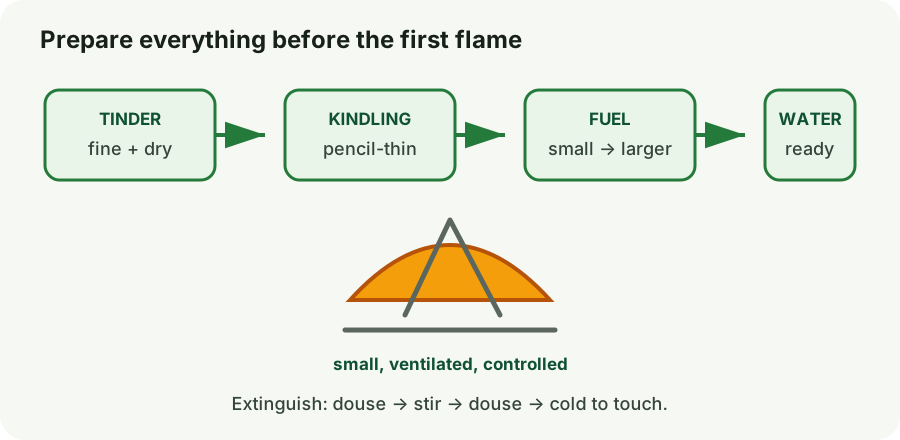
Tinder, kindling, and fuel preparation
- Tinder: prepare a loose, dry bundle that catches from your ignition source.
- Fine kindling: collect a large handful of matchstick/pencil-thin pieces.
- Medium fuel: prepare finger- to thumb-thick sticks.
- Larger fuel: have only enough for the intended duration; small emergency fires are easier to control.
- Keep it dry. Split damp wood to expose a drier interior and keep prepared material under cover.
Ignition methods
- Lighter: shield from wind and light the tinder at its lowest edge.
- Storm/water-resistant match: strike only after the tinder and next fuel sizes are ready.
- Ferrocerium rod: direct sparks into fine prepared tinder; keep the rod stable and scrape with controlled movement.
- Commercial fire starter: follow the product instructions and keep it under the tinder/kindling where flame can rise through fuel.
- Do not rely on friction fire in an actual emergency unless already skilled. It is practice-intensive and conditions-sensitive.
Fire lays and wet-weather technique
- Teepee: lean fine kindling around/over tinder with air gaps; good for quick flame growth.
- Log-cabin/grid support: stack small fuel in crossed layers around a tinder core for airflow and stability.
- Wet weather: search under dense conifers, dead standing branches, or inside split wood for dry material where collection is legal.
- Raise the start from saturated ground. A small platform of dry sticks/bark can isolate tinder from mud/snow without enclosing the flame.
- Feed small to large. Add one size at a time only after the previous layer is burning strongly.
Extinguishing and fire-site safety
- Stop adding fuel early. Let remaining wood burn down while you still have water/time.
- Douse thoroughly. Pour water over flames, coals, and the surrounding hot area.
- Stir and expose. Break apart coals and mix water through the ash.
- Repeat until cold. Add more water, stir again, and carefully confirm the remains are cold to the touch.
- Never leave a fire unattended. Wind can revive apparently dead coals hours later.
Important limit
Do not use charcoal, campfires, grills, or fuel-burning stoves inside tents, vehicles, cabins, or other enclosed/partly enclosed spaces unless the appliance is specifically installed and vented for that use. Carbon monoxide can kill without warning.
Practice before an emergency
- Build a cold fire lay with no ignition and check whether every fuel size is ready.
- Practice lighting a fire starter outdoors in legal controlled conditions with water beside you.
- Try splitting damp practice wood to find the dry interior.
- Time how long complete extinguishing actually takes.
- Maintain a non-fire backup for warmth, cooking, and signaling.
Use guides as references, not substitutes for training
Conditions, local law, official emergency instructions, product instructions, and hands-on training can change what is appropriate. When an emergency service or responsible authority gives you a specific instruction for the active incident, follow it.
Source links are included so the guide can be checked against current official guidance. Review dates and local instructions before high-risk travel or seasonal hazards.
Related essential field guides
Additional procedures and printable references: