Immediate rule
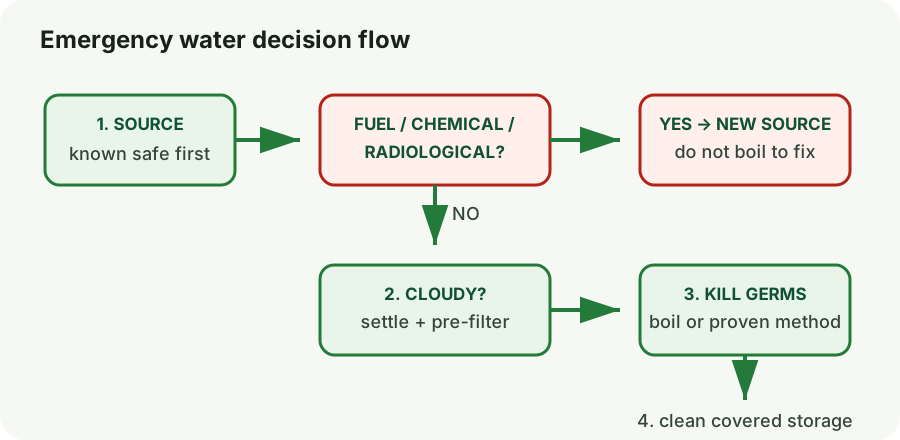
Five skills to master
Learn these five competencies in order. Each section below gives a rule, a procedure, and the boundaries that prevent common mistakes.
Choose the safest source
- Best first: sealed commercial water or a source declared safe by the responsible authority.
- Next: protected flowing water or collected rainwater when local conditions make those plausible and no safe municipal supply exists.
- Avoid obvious contamination. Do not collect near sewage, livestock concentrations, fuel sheen, industrial runoff, mine drainage, algal blooms, or chemical odor.
- Respect advisories. “Boil water,” “do not drink,” and “do not use” mean different things. Follow the exact local instruction.
- Chemicals change the plan. Water suspected of fuel, toxic chemicals, or radioactive material should be replaced with another source, not boiled harder or longer.
Settle and pre-filter cloudy water
- Let it settle. Leave muddy water undisturbed until heavier sediment falls to the bottom.
- Decant. Pour the clearer upper layer into another clean container without stirring the sediment.
- Pre-filter. Pass the water through a clean cloth, paper towel, or coffee filter if available.
- Repeat if needed. Clarification is a preparation step, not purification.
- Then disinfect. Continue to boiling or a proven product-based treatment.
Boil correctly
- Use clear water. Clarify cloudy water first.
- Bring to a full rolling boil. Keep it boiling for 1 minute; above 6,500 ft / ~2,000 m, boil for 3 minutes.
- Let it cool covered. Do not add untreated water or ice.
- Transfer cleanly. Use sanitized containers and avoid touching the inside of caps, bottle mouths, ladles, or storage vessels.
- Label if necessary. Keep untreated and treated containers visually distinct.
Important limit
Boiling kills germs but does not remove fuel, many toxic chemicals, or radioactive contamination. In some chemical scenarios it can concentrate contaminants as water evaporates.
Filter or disinfect when boiling is unavailable
- Read the rating. Filters differ in pore size and in whether they address protozoa, bacteria, and viruses.
- Combine methods when necessary. A filter that does not reliably address viruses may need a compatible disinfectant afterward.
- Use chemical disinfectants exactly as labeled. Dose and contact time depend on product concentration, water clarity, temperature, and target organisms.
- Keep clean and dirty sides separate. Do not let the untreated inlet hose, hands, or bottle threads contaminate treated water.
- Do not trust improvised charcoal/sand bottles as purification. They can improve appearance but are not a substitute for validated treatment.
Store treated water without re-contamination
- Use sanitized, covered containers. Narrow-mouth containers reduce hand contact.
- Pour instead of dipping. Avoid shared cups or hands entering the storage vessel.
- Keep off dirty floors and flood-contaminated surfaces. Protect the cap and opening.
- Separate raw and treated water physically. Use different colors or labels.
- Make the next batch before you are empty. Treatment takes time and emergencies disrupt routines.
Practice before an emergency
- Boil and cool one liter of water using your emergency stove outdoors where legal.
- Practice settling and decanting muddy-looking test water, then discard it rather than drinking practice water.
- Learn the exact filter/disinfectant model in your kit and record its limitations.
- Sanitize and label two storage containers “UNTREATED” and “TREATED.”
- Download the local drinking-water advisory page for offline access.
Use guides as references, not substitutes for training
Conditions, local law, official emergency instructions, product instructions, and hands-on training can change what is appropriate. When an emergency service or responsible authority gives you a specific instruction for the active incident, follow it.
- CDC — How to Make Water Safe in an Emergency
- CDC — Drinking Water Advisories
- CDC — Water Treatment When Hiking, Camping, or Traveling
Source links are included so the guide can be checked against current official guidance. Review dates and local instructions before high-risk travel or seasonal hazards.
Related essential field guides
Additional procedures and printable references: