Immediate rule
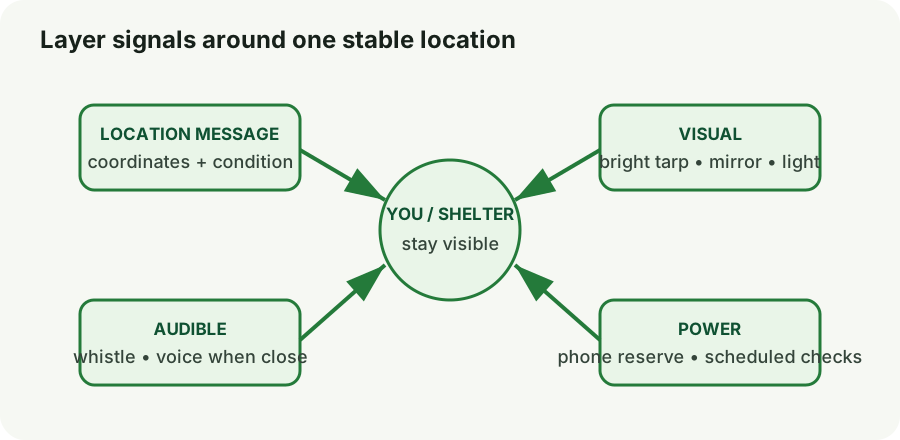
If you are lost or immobilized and moving is not clearly safer, stop, shelter, send your exact location, and make yourself conspicuous. A stable target is easier for rescuers to find than a moving one.
Five skills to master
Learn these five competencies in order. Each section below gives a rule, a procedure, and the boundaries that prevent common mistakes.
Emergency call and location report
Rule: A useful distress message tells rescuers who, what, where, how many, and what hazards they will encounter.
- Call the local emergency number when service exists. If a satellite SOS device is available, use its emergency function as designed.
- Give precise location. Coordinates, trail/road name, nearest landmark, elevation if known, direction from a known point, and visible terrain features all help.
- Describe the emergency. Injury/illness, number of people, weather, shelter, supplies, and whether the group can move.
- Give identifying details. Clothing colors, tent/tarp color, vehicle description, and phone number/device contact.
- Follow callback instructions. If rescuers may call back, keep the device powered and do not move merely to chase stronger signal unless instructed.
Stay-or-move decision
Rule: If nobody knows exactly where you are going and the route is uncertain, unnecessary movement makes search harder.
- Stop and stabilize. Treat injuries, get out of weather, and inventory water, warmth, light, and communication.
- Stay put when: you are lost, injured, darkness/weather makes travel unsafe, or rescuers have your location.
- Move only for a clear reason: immediate hazard, a known nearby safe point, or responder instruction.
- If you must move: leave a clear note/marker with time, direction, destination, names, and condition where it can be found without damaging the environment.
- Do not follow watercourses blindly. Canyons, waterfalls, cliffs, and flood hazards can make them dangerous travel routes.
Audible and visual signaling
Rule: Use repeated, high-contrast signals that can be noticed from several directions without exhausting yourself.
- Whistle: use short repeated blasts instead of continuous shouting. A whistle carries farther and costs less energy.
- Mirror: in sunlight, aim flashes toward aircraft, roads, boats, or distant observers; never stare at the reflection.
- Color: spread bright clothing, tarp, or gear in an open area with strong contrast against the ground.
- Light: use a flashlight/headlamp in deliberate repeated bursts at night while conserving battery.
- Ground marker: make a large simple high-contrast marker in an open area only when it is safe and legal; do not spend hours on elaborate symbols when shelter or medical care is more urgent.
Phone and battery management
Rule: Preserve the phone for location, calls, texts, maps, and responder contact—not entertainment.
- Send location early. A successful text may work when a voice call fails and can give rescuers a fixed reference.
- Use low-power mode. Dim the screen, close nonessential apps, and disable unnecessary radios/services while keeping needed emergency connectivity.
- Keep the phone warm in cold conditions. Batteries lose performance when cold.
- Use airplane mode only when you are intentionally pausing network search. Turn cellular/satellite functions back on for scheduled checks or responder contact.
- Protect the charging reserve. Keep the power bank dry and avoid draining it on high-load tasks.
Rescue contact and handoff
Rule: When rescuers are close, follow instructions and avoid creating new hazards with sudden movement, smoke, fire, or approach to aircraft.
- Make the site obvious. Put bright material where it can be seen without blocking a landing/approach area.
- Keep loose items secured around helicopters. Do not approach an aircraft until directed.
- Report changes. If the person worsens, weather changes, or the group moves for safety, send an update.
- Prepare information. Names, medical issues, medications/allergies if known, injury timeline, first aid given, and remaining hazards.
- Let the rescue team control extraction. Do not improvise rope, cliff, swift-water, or vehicle recoveries beyond your competence.
Practice before an emergency
- Store your phone’s coordinate display method and learn how to read it aloud.
- Carry a whistle on your person, not buried in the pack.
- Practice aiming a signal mirror at a stationary target away from roads/aircraft.
- Create a one-message emergency template with group size, location, injury, and clothing/tarp colors.
- Leave a trip plan with a contact for remote outings.
Use guides as references, not substitutes for training
Conditions, local law, official emergency instructions, product instructions, and hands-on training can change what is appropriate. When an emergency service or responsible authority gives you a specific instruction for the active incident, follow it.
Reference sources:
Source links are included so the guide can be checked against current official guidance. Review dates and local instructions before high-risk travel or seasonal hazards.
Related essential field guides
Additional procedures and printable references: