Before you begin
Transponders and automatic identification systems broadcast structured information. The best beginner project is reception and decoding of publicly broadcast ADS-B and AIS—not probing, interrogating or retransmitting.
Six practical skills
Distinguish aviation and marine broadcasts
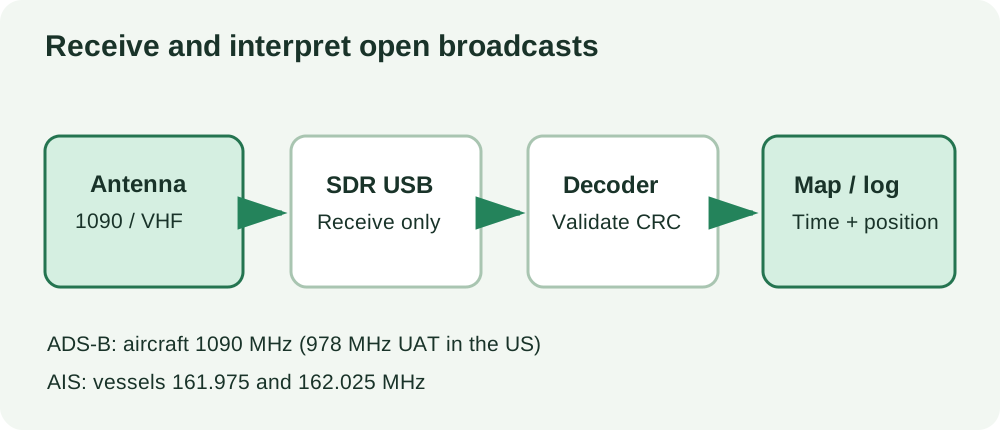
Aircraft Mode S/ADS-B Extended Squitter is typically received at 1090 MHz. In the United States, UAT ADS-B also uses 978 MHz. Ships generally use AIS 1 at 161.975 MHz and AIS 2 at 162.025 MHz. Mode S interrogation at 1030 MHz is a separate system, not the normal ADS-B downlink.
Select receive-only equipment
Use an RTL-SDR or equivalent receive-capable dongle and a suitable 1090 MHz antenna for ADS-B, or a marine-VHF antenna for AIS; use a computer with sufficient power. An antenna must suit its frequency; expect range to vary with terrain, height and line of sight.
Connect and confirm a signal
Install SDR drivers and an established ADS-B decoder (for example readsb or dump1090) or AIS decoder (for example AIS-catcher) from their official project repositories. Choose the correct center frequency, gain and sample rate according to the receiver and decoder documentation. Do not transmit.
Interpret typical decoded fields
ADS-B may carry an aircraft identifier, position, altitude, ground speed and heading. AIS may carry an MMSI identifier, navigation status, position, course and speed. A record is meaningful only if its timestamp and validity flags are known.
Validate and account for missing data
Use a decoder that checks framing and CRC where applicable. Missing position, random-looking identifiers, stale timestamps and local reception gaps are common. Not every aircraft/vessel is required to broadcast usable position; no single SDR gives complete coverage.
Handle received data responsibly
Compare with trusted public reference feeds where permitted, and avoid publishing private or sensitive movements. Respect local radio monitoring and data-sharing laws. For emergencies rely on official rescue services rather than an SDR screen.
Example decoder worksheet
The following labels are illustrative, not a live or verified aircraft record. Log only information a legitimate receiver reports.
| Decoder field | What it means | Check before using |
|---|---|---|
| Timestamp UTC | Time the local receiver or decoder saw the frame. | Is your clock synchronized, and is this report recent? |
| Identity (ICAO / MMSI) | Broadcast aircraft or maritime identifier. | It is not proof of a real-world identity. |
| Latitude / longitude | Reported location when position messages are available. | Look for freshness, quality flags and plausible movement. |
| Altitude / speed / course | Reported motion fields, which differ between ADS-B and AIS. | Confirm units, reference frame, missing-data indicators. |
| Message integrity | Frame or CRC validation status. | Reject corrupt records and treat decoded values as advisory. |
Related guides
Reference sources
Verify local laws and manufacturer guidance before field use. Information reviewed November 2026.