Immediate rule
For an immediate threat, call the local emergency number. For household check-ins, use a short text message and a written meeting plan; never delay evacuation to charge a phone.
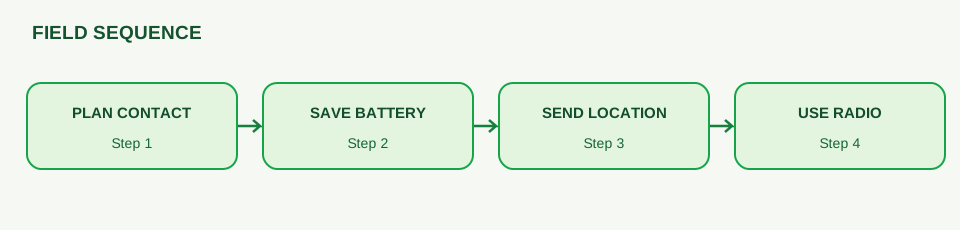
Five practical skills
A concise, repeatable field sequence. Read these before an emergency and follow official incident instructions when they differ.
Create a contact and regrouping plan
Rule: A simple printed plan works when apps and mobile data fail.
- Choose one trusted out-of-area contact who can relay status among household members.
- Write emergency numbers, medical contacts, building details and two meeting places on waterproof paper.
- Agree on a short check-in message format: name, location, condition and intended next step.
Make battery power last
Rule: Save charge before it reaches a critical level.
- Charge a power bank ahead of travel and check it regularly. Carry the correct cables and a small plug-in charger.
- Reduce brightness, switch to low-power mode and disable unnecessary background downloads, streaming and location sharing.
- Use airplane mode only when you do not need alerts or calls; switch connectivity back on to check warnings and send updates.
Communicate briefly and precisely
Rule: Short texts often work with less bandwidth than long calls.
- Try emergency calling first for an active life-threatening incident. If a call fails, use officially supported emergency text services only where available.
- For routine check-ins, send one concise SMS with your last known location and condition; avoid flooding the network with repeated calls.
- Share precise location using an address, landmark, road marker or coordinate pair, plus the time the position was measured.
Use backups for local information
Rule: Radio and paper can outlast a data connection.
- Carry a battery- or hand-crank-powered radio tuned to locally available emergency broadcasts.
- Save offline maps and learn to read a paper map before leaving; mobile GPS may work without cellular data, but maps may not load.
- Use local government alerts and official channels rather than unverified social-media rumors.
Signal and wait for help safely
Rule: Choose a stable, visible position and keep a reserve for rescue contact.
- If lost, avoid random movement once your location can be reported accurately, unless remaining there is dangerous.
- If appropriate, use a whistle or bright marker to draw attention, while avoiding fire or smoke signals in hazardous conditions.
- Keep your phone accessible with a small reserve of battery and follow rescue service instructions exactly.
Practice before an emergency
- Set up a printed emergency contact card.
- Store an offline map and practice reading a GPS coordinate.
- Test the emergency radio and power bank every few months.
Safety and local guidance
These notes are practical references, not a substitute for professional training or location-specific alerts. Follow emergency responders and local laws.
Reference sources:
- American Red Cross — Power Outage Safety
- American Red Cross — How to Prepare For Emergencies
- National Weather Service — Wireless Emergency Alerts
Links are provided to help you verify these recommendations and updates.
Related essential field guides
Additional procedures and printable references: