Immediate rule
Fishing is a supplemental food strategy, never a substitute for safe water, shelter or rescue. Follow local laws and consumption advisories; never eat unidentified or spoiled fish.
Five practical skills
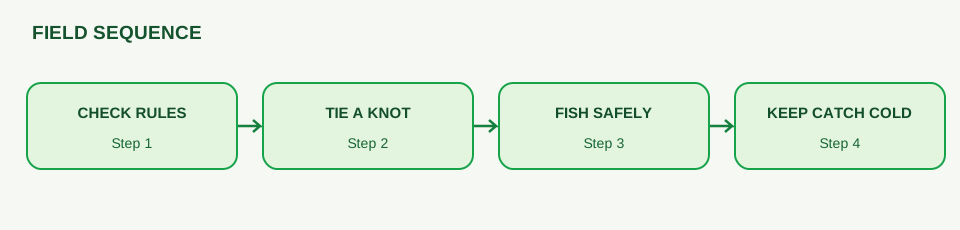
A concise, repeatable field sequence. Read these before an emergency and follow official incident instructions when they differ.
Check permission, water and fish safety
Rule: Fishing and keeping a catch are subject to local restrictions.
- Check local licenses, seasons, no-take areas, permitted gear, size limits and species protections before casting.
- Check water-quality and fish-consumption advisories; polluted water may make otherwise edible fish unsafe.
- Choose stable banks away from swift currents, deep edges, overhead power lines and boat traffic. Wear flotation around water when appropriate.
Build a compact fishing kit
Rule: Carry simple, reusable tackle rather than a complicated setup.
- Use a basic rod or handline where lawful, suitable line, a few small hooks, split-shot sinkers, a float, spare leader and pliers.
- Store hooks covered and lines untangled. Pack a small cloth, clean container and hand cleaner for fish handling.
- Match bait and hooks to local fish. Do not assume all fish respond to improvised bait or that a fishing kit guarantees food.
Tie a reliable attachment knot
Rule: Practice a simple knot on ordinary monofilament before the trip.
- For an improved clinch knot, pass the line through the hook eye, wrap the tag end around the standing line several times, feed it through the first loop and then through the larger loop formed.
- Moisten and pull the knot tight slowly. Trim the tag end with a small margin and pull-test the connection.
- Use a different knot when a line or hook manufacturer recommends one; the improved clinch knot is not optimal for every braided line.
Handle fish and hooks safely
Rule: Avoid injury and needless delay after a catch.
- Keep fingers clear of hooks and spines; use pliers to remove a hook, or cut the line when removal is unsafe.
- Identify the species before retaining it. Release prohibited, protected or unknown fish promptly and gently.
- After contact with raw fish, wash hands and sanitize tools before touching ready-to-eat food.
Keep, cook and eat fish safely
Rule: Fish spoils quickly; there is no safe improvised shortcut for raw fish.
- Chill freshly caught fish on ice at 4°C / 40°F or colder as soon as possible. If safe chilling is impossible, cook promptly and do not save leftovers without refrigeration.
- Cook fish to an internal temperature of 63°C / 145°F or until the flesh is opaque and separates easily, according to food-safety guidance.
- Never rely on taste, smell or cooking alone to remove pollutants, marine biotoxins or chemical contaminants. Follow current local advisories.
Practice before an emergency
- Practice a knot indoors until it survives a pull test.
- Look up local fishing laws and advisories before travel.
- Pack a fishing pliers, a measuring device and a safe ice plan.
Safety and local guidance
These notes are practical references, not a substitute for professional training or location-specific alerts. Follow emergency responders and local laws.
Reference sources:
- Fishing with Nat — Improved Clinch Knot Tutorial
- EPA — Eating Fish and Shellfish Safely
- US FDA — Safe Food Handling
Links are provided to help you verify these recommendations and updates.
Related essential field guides
Additional procedures and printable references: